News
As AI servers, optical modules, power electronics, automotive electronics, and smart devices continue to evolve toward higher power density, greater integration, and more compact form factors, thermal management is becoming increasingly critical to system performance and reliability.
Higher heat fluxes at processors, power semiconductors, and optoelectronic devices can lead to localized hot spots and increased thermal loads. At the same time, surface roughness, assembly tolerances, component warpage, and thermal expansion can create or change interfacial gaps between heat-generating components and heat-dissipating structures.
In these demanding environments, a thermal interface material (TIM) must do more than provide high thermal conductivity. It must also deliver low thermal resistance, effective surface conformity, mechanical compliance, and long-term stability.
Traditional thermal greases and conventional thermal pads may face challenges related to thermal performance, interface contact, mechanical deformation, aging, or oil bleed under demanding operating conditions. As a result, high-heat-flux applications require TIMs with a more balanced combination of thermal and mechanical properties.
High-performance processors, power devices, and optoelectronic components generate increasing amounts of heat within increasingly compact packages.
An effective TIM must establish a reliable thermal pathway between the heat source and the heat sink while minimizing thermal resistance across the interface.
Real-world component and heat sink surfaces are not perfectly flat. Microscopic surface roughness, assembly tolerances, and component warpage can create air gaps between mating surfaces.
Because air has very low thermal conductivity, these gaps can act as thermal barriers. A compliant TIM helps fill surface irregularities and maintain effective contact between the heat-generating component and the cooling structure.
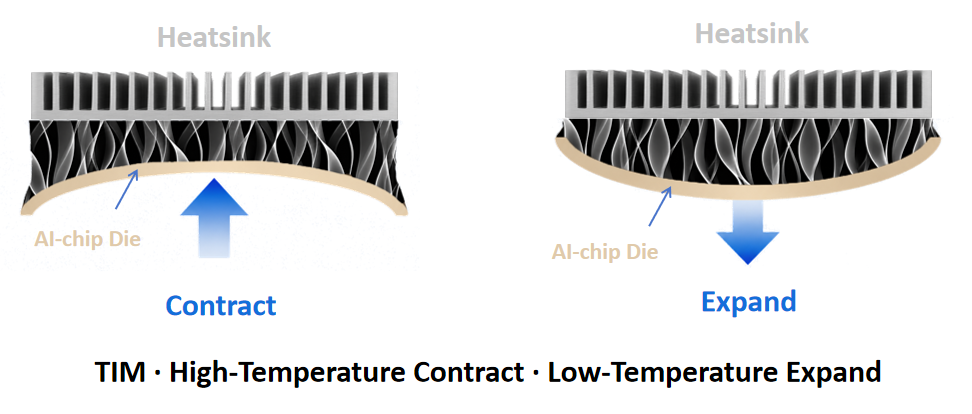
Electronic assemblies can experience repeated temperature changes, mechanical vibration, and dimensional changes caused by thermal expansion and contraction.
The TIM therefore needs sufficient flexibility and recovery capability to accommodate changes in the interface and maintain stable thermal contact throughout operation.
For applications requiring long-term reliability and material cleanliness, excessive oil bleed or volatile components can become a concern, particularly around sensitive electronic and optical components.
Stable material performance over extended operating periods is therefore an important consideration when selecting a thermal interface material.
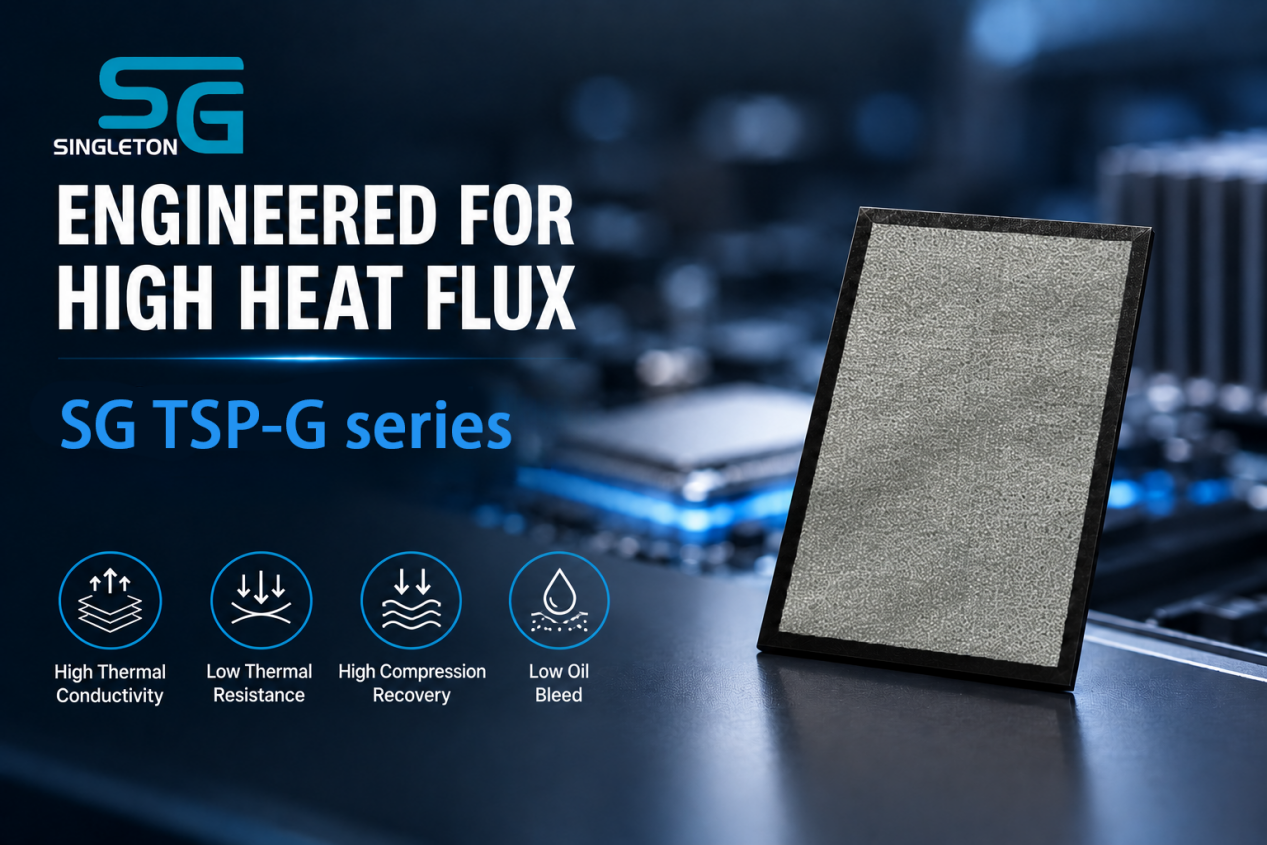
To address the combined thermal and mechanical requirements of high-heat-flux electronics, Singleton has developed a series of vertically aligned graphene thermal pads (SG TSP-G series).
The SG TSP-G Series is engineered from structurally modified graphene foam and utilizes a specialized vertical alignment process to establish an oriented thermal conduction pathway. This engineered structure delivers high thermal conductivity while maintaining compressibility, resilience, and interfacial conformability, enabling effective adaptation to varying interface gaps and assembly tolerances for efficient and stable heat transfer in high-heat-flux applications.
The SG TSP-G Series is available in multiple thermal conductivity grades of 70 / 90 / 110 / 130 / 170 W/m·K. A graded portfolio of thermal conductivity and thickness options enables material selection based on different heat flux levels, interface gaps, and assembly conditions. With precision die-cutting, edge encapsulation, and structural customization, the series can be tailored to specific application requirements, providing flexible and application-oriented TIM solutions.
| Property | Unit | Typical Value | Test Standard | |||||
|---|---|---|---|---|---|---|---|---|
| Thermal Properties | Thermal Conductivity | W/m·K | 70 | 90 | 110 | 130 | 170 | ASTM D5470 |
| Thermal Resistance@40Psi | ℃·cm2/W | 0.12 | 0.1 | 0.08 | 0.06 | 0.04 | ASTM D5470 | |
| Operating Temperature | ℃ | -40~+150 | -40~+150 | -40~+150 | -40~+150 | -40~+150 | SG Internal Method | |
| Physical Properties | Color | / | Black | Black | Black | Black | Black | Visual Inspection |
| Density | g/cm3 | 0.7~0.9 | 0.7~0.9 | 0.7~0.9 | 0.7~0.9 | 0.7~0.9 | ASTM D792 | |
| Thickness Range | mm | 0.15~2.0 | 0.15~2.0 | 0.15~2.0 | 0.15~2.0 | 0.15~2.0 | ASTM D374 | |
| Tensile strength | MPa | 0.05 | 0.05 | 0.05 | 0.03 | 0.03 | ASTM D412 | |
| Compression Rebound Rate | % | ≥55 | ≥55 | ≥55 | ≥55 | ≥55 | ASTM D575 | |
| Oil Bleeding Rate | % | ≤1.5 | ≤1.5 | ≤1.5 | ≤1.5 | ≤1.5 | SG Internal Method | |
| Other Properties | Flame Retardant Rating | / | V0 | V0 | V0 | V0 | V0 | UL94 |
The vertically aligned graphene structure of SG TSP-G provides efficient through-plane heat conduction and continuous thermal pathways.
With thermal conductivity of 70–170 W/m·K and thermal resistance of 0.12–0.04 °C·cm²/W @ 40 psi, the series is designed for medium to ultra-high heat flux applications.
With a compression recovery rate of ≥55%, SG TSP-G accommodates surface irregularities, assembly tolerances, and component or substrate warpage.
Its compliant structure helps maintain intimate contact under compression and thermal cycling, supporting stable interfacial thermal performance.
With a density of 0.7–0.9 g/cm³, SG TSP-G combines high thermal conductivity with a lightweight structure.
It is suitable for applications where thermal performance, weight, and installation space are key design considerations.
With an oil bleeding rate of ≤1.5% and low-volatility formulation, SG TSP-G helps minimize material migration and contamination during long-term operation.
This makes it suitable for electronic assemblies where cleanliness and long-term reliability are critical.
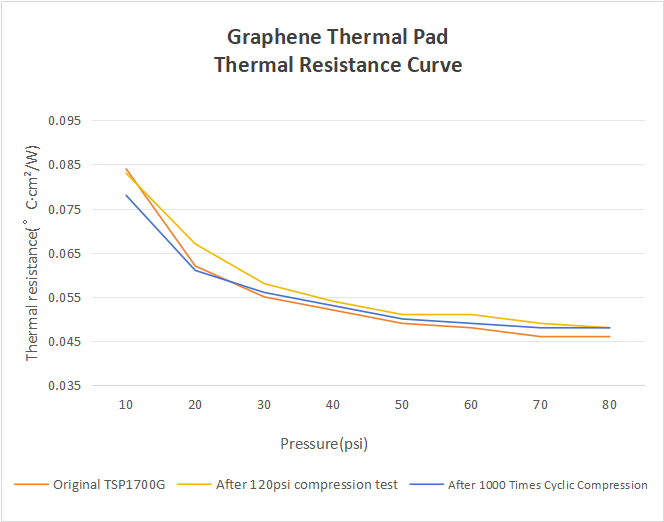
SG TSP-G withstands compression loads up to 120 psi and 1,000 compression cycles. After testing, no visible surface damage was observed, with thermal resistance change of <5%. The compression and cycling resistance helps maintain stable interfacial contact and thermal performance under repeated loading and assembly conditions.
Singleton vertically aligned graphene thermal pads are designed for thermal management applications requiring a combination of high thermal conductivity, low thermal resistance, mechanical compliance, and long-term stability.
For CPUs, GPUs, accelerators, and other high-power semiconductor devices where increasing heat flux places greater demands on thermal interfaces.
For optical modules and high-power optoelectronic components where efficient heat transfer, compact form factors, and material cleanliness are important.
For power semiconductors, inverters, power modules, and electronic control systems requiring efficient thermal coupling under demanding operating conditions.
For vehicle computing platforms, domain controllers, power electronics, and other automotive electronics exposed to temperature variation and mechanical environments.
For high-power communication modules, wireless infrastructure, and 5G/6G equipment where thermal performance and long-term reliability are critical.
For industrial computing, control systems, instrumentation, and other high-performance electronic assemblies with demanding thermal requirements.
Thermal interface selection is application-dependent. In addition to thermal conductivity, engineers need to consider thermal resistance, interface gap, compression load, mechanical compliance, operating temperature, material cleanliness, and assembly space.
Singleton's graphene thermal pad portfolio provides multiple thermal conductivity grades from 70 to 170 W/m·K, together with thickness options from 0.15 to 2.0 mm.
This graded approach allows engineers to select a suitable TIM according to the specific thermal and mechanical requirements of each application.
As electronic systems continue to move toward higher power density and greater integration, thermal interface materials are becoming an increasingly important part of system-level thermal design.
Singleton's vertically aligned graphene thermal pads combine a directional thermal structure, high thermal conductivity, low thermal resistance, high recovery, low density, and low oil bleed to address the combined thermal and mechanical challenges of high-performance electronic assemblies.
From high-power computing and optical communications to power electronics and automotive systems, Singleton provides a portfolio of graphene-based TIM solutions designed to support efficient and reliable thermal management.
Custom thicknesses, dimensions, and thermal conductivity grades are available.
Contact Singleton for product specifications, technical data, sample evaluation, and application-specific material selection support.